On Friday 17th October the Third Committee held its discussion on the Right to Food, featuring the presentation of the report by the Special Rapporteur on the Right to Food, Mr. Michael Fakhri. The session focused on the growing concentration of corporate power in global food systems and its impact on human rights, sovereignty, and access to adequate nutrition.
The Special Rapporteur expressed deep concern over the extent to which transnational corporations dominate global food production and supply chains. He emphasized that a small group of corporate actors now determines what is grown, how it is produced, and at what cost, often prioritizing profit over the public good. Mr. Fakhri warned that this concentration of power has led to environmental degradation, the erosion of labour rights, and systemic human rights violations. He underscored that States, by ceding sovereignty to corporate interests, have weakened their ability to ensure the right to food for their populations.
He further noted the increasing digitalization of food systems, cautioning that without appropriate regulation, new technologies could deepen inequities rather than resolve them. The Special Rapporteur attributed the recent surge in food prices largely to corporate profiteering and market concentration, rather than to genuine supply shocks.
In his concluding remarks, the Special Rapporteur drew attention to the interlinkages between food insecurity, armed conflict, and international justice. He highlighted the situation in Gaza as an example of how starvation can be weaponized, calling upon the General Assembly to act decisively through a Uniting for Peace resolution to ensure humanitarian access and accountability.
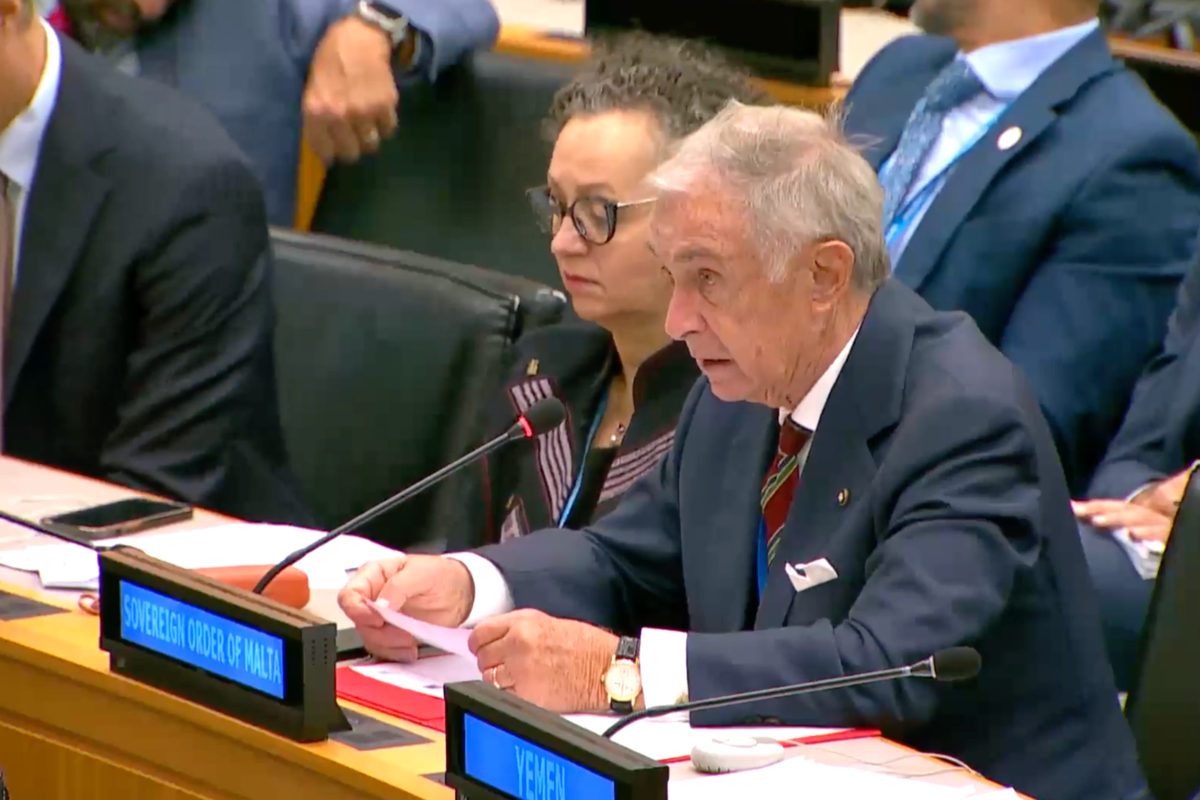
Following the presentation, Margherita Calice, the representative of the Sovereign Order of Malta delivered a statement reaffirming that the right to food is not a privilege but a precondition for peace. Shr stressed that food insecurity stems not from global scarcity but from structural inequality and poor distribution. Through its humanitarian relief agency, Malteser International, the Order underscored its commitment to multi-sectoral and sustainable solutions, citing its school feeding programme in South Sudan that provides over 2,000 children with a daily meal, encouraging education and stability.
The Order emphasized three key imperatives:
- That freedom from hunger is a non-negotiable right;
- That hunger results from systemic failures requiring multilateral correction; and
- That global cooperation is essential to pair emergency relief with long-term strategies for nutrition, education, and livelihoods.
In line with its humanitarian mandate, the Sovereign Order of Malta reaffirmed its determination to uphold human dignity through practical action and multilateral engagement, urging all Member States to treat the right to food as central to peace, security, and sustainable development.