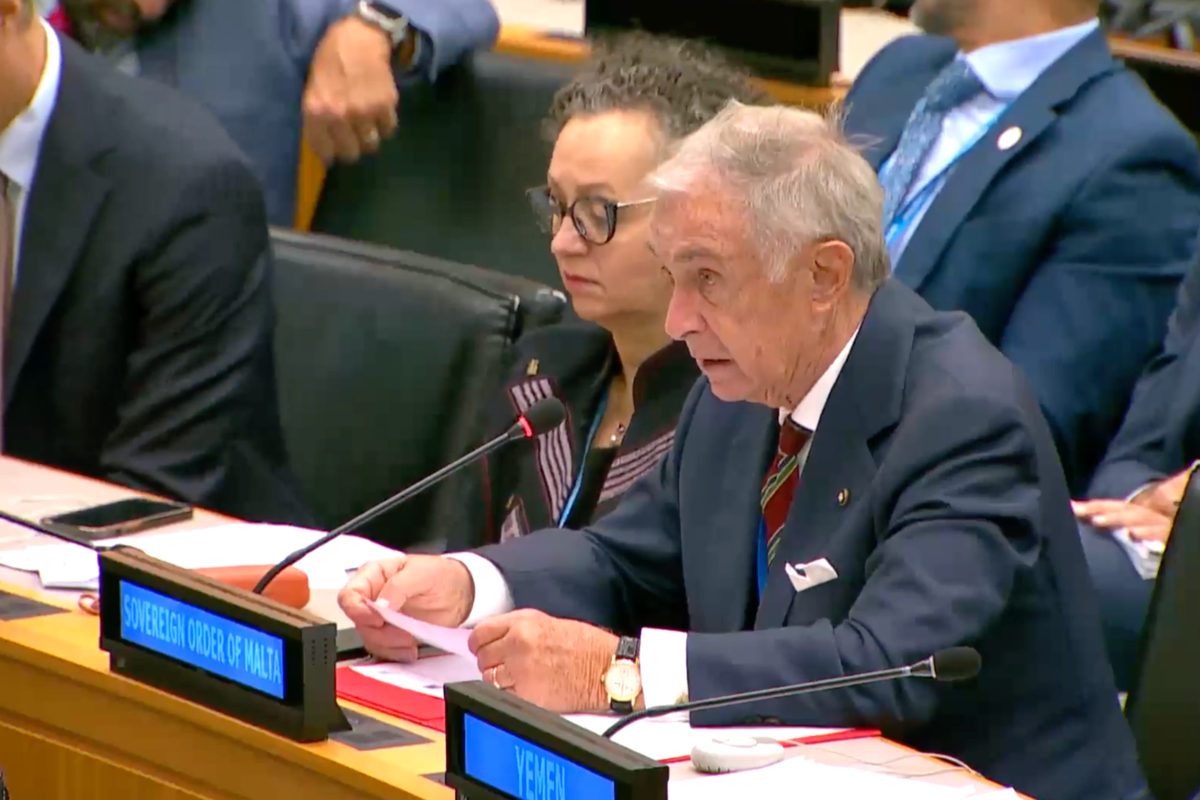
On 7th October 2026, Counsellor Dr. Michael Espiritu, speaking on behalf of the Sovereign Order of Malta, addressed the Third Committee on the Human Rights of Older Persons, led by the Independent Expert on the Enjoyment of all Human Rights by Older Persons, Mr. Zvezdan Pirtošek.
Mr. Pirtošek presented the findings of his recent reports entitled ‘Autonomy, Dignity and the Enjoyment of Human Rights in Situations of Dependency in Older Age’ and on ‘Cognitive Impairment and the Continuing Exercise of Human Rights by Older Persons’. He stressed that in public policy and everyday language, dependency is often associated with frailty, decline and loss. There is a risk that we see someone who is dependent less as a person who acts, decides, and participates, and more as someone to be protected and managed. He emphasised that dependency is not the opposite of autonomy. Indeed, human beings live in relationships of interdependence throughout life, including during times of illness, relocation, and grief. In these instances, we may lean on people, but this does not reduce our dignity or need to live our own lives. Furthermore, dependency is also shaped by the environment in which someone lives – housing may be inaccessible, transport options few, services unaffordable, or support options simply don’t exist. He stressed that whilst a move into residential care may be a choice for some, we should not confuse necessity with choice in every instance.
He called for a rights-realising system that does not just ask what care this person needs but also asks they want and how can they remain part of the life they had before. Older people must have meaningful choices about where and with whom they live, and help discerning what support will be needed to allow them to achieve these goals. He called for the strengthening of accessible communication, meaningful participation in care and daily life, protection from coercion, and accountability when rights are restricted or ignored.
Furthermore, he highlighted the key role families play in supporting older relatives but stressed that they cannot be treated as an unlimited private resource. Care-givers need respite, information, and social protection, whilst the rights and protections of the older person remain central. Additionally, Mr. Pirtošek noted that this is a gender equality question, as a greater proportion of care-givers and older persons are women.
Agism can then compound risks – loss of choice is too easily accepted as inevitable; isolation is common; and institutionalisation can be seen as the natural consequence of aging. However, these are consequences of how society organises support for older people, often focusing on clinical outcomes and costs (which are important), but failing to identify if someone can continue to live their life in the way they want. He called for the international community to respect the autonomy and legal capacity of older people, and prevent neglect, violence, and coercion. We must ensure that the absence of alternatives does not become an inevitable pathway to institutionalisation. Needing another person must never mean becoming less of a person.
Speaking on behalf of the Sovereign Order of Malta, Counsellor Dr. Michael Espiritu highlighted the estimate from the UN High Commissioner for Human Rights that by 2050, one in six people will be aged 65 and over. However, their rights are vulnerable and they are often at risk of agism, neglect and abuse.
Counsellor Espiritu emphasised that the Silver Economy presents a significant opportunity for promoting inclusive growth and sustainable development through investments in solutions that support healthy aging and create new markets and employment opportunities. He highlighted the extensive work of the Sovereign Order of Malta in delivering care to the elderly, particularly through our care homes and programmes across Europe. In particular, he drew attention to our mobile care services in Austria, the assisted transport options we offer in central Scotland, and our ‘Warmth for Ukraine’ initiative that provided fuel and warmth aids during prolonged power outages last winter. He ended by calling on the international community to uphold the sanctity of life by protecting the most vulnerable and ensuring that older people can live lives of dignity and respect.