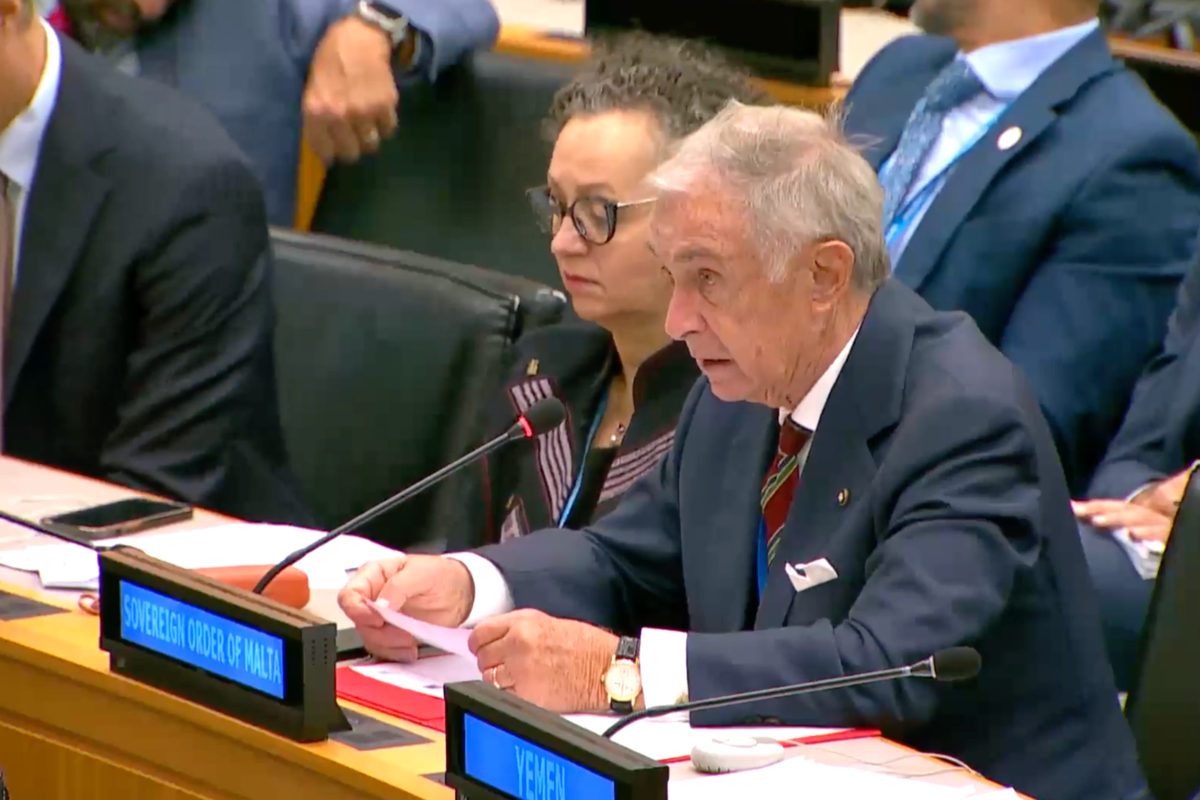
On October 21st, Counsellor Dr. Michael Espiritu delivered a statement at the United Nations General Assembly Third Committee on the topic of “Human Rights of Migrants.”
The session featured Mr. Gehad Madi, Special Rapporteur on the human rights of migrants, who presented his annual report on the externalization of migration governance and its human rights implications.
Mr. Madi warned that transferring migration control responsibilities to third countries has become a defining feature of modern migration and border policies, often resulting in grave human rights risks. He outlined three main forms of externalization—prevention of arrival, outsourcing of asylum processing, and returns or transfers to third states—and stressed that such arrangements frequently lead to violations of fundamental rights, including the prohibition of arbitrary detention, collective expulsion, and enforced disappearance. He urged States to ensure transparency and accountability through human rights impact assessments and monitoring mechanisms, and reminded them that delegating border control to third states does not absolve their international obligations.
Dr. Michael Espiritu, in his intervention, reaffirmed the Order’s commitment to protecting the dignity and rights of migrants, noting that over 304 million migrants are currently recorded worldwide—nearly double the number in 1990. He drew attention to the humanitarian toll of displacement, citing 12 million people displaced in Sudan, over 7 million in Venezuela, and hundreds of thousands in South Sudan uprooted by floods. Recalling Pope Francis’s words that “Migrants are not a danger; they are in danger,” he emphasized that hostility and xenophobia erode our shared humanity.
Since 2008, the Order had been present at Lampedusa—one of the Mediterranean’s main landing points for migrants—offering emergency medical care, psychological support, and humanitarian assistance. This commitment continues across Italy and Europe, where volunteers and medical teams accompany migrants and asylum seekers with compassion and respect for their dignity.
He concluded that migration must be addressed through solidarity rather than fear, reaffirming that “migration is not a crisis to be managed, but a shared human reality that calls for cooperation among all nations.” The discussion underscored the shared responsibility of States and humanitarian actors to ensure that migration policies remain grounded in human rights, dignity, and compassion—principles that guide the Order of Malta’s work around the world.