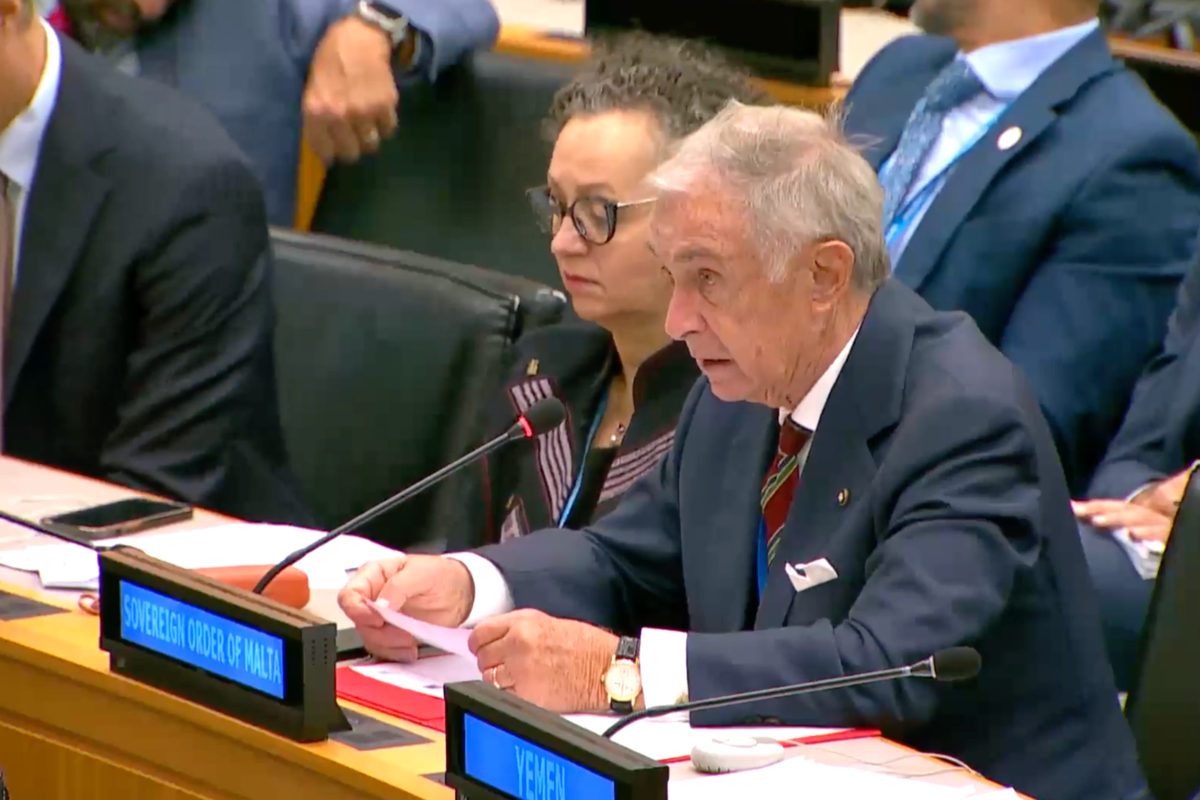
On October 24th, Solène Vielfaure, Diplomatic Trainee, addressed the Third Committee on the Freedom of Religion or Belief, led by Dr. Nazila Ghanea.
The Special Rapporteur on freedom of religion or belief, Dr. Nazila Ghanea, presented a new report to the General Assembly focusing on the right to freedom of religion or belief (FoRB) for people on the move—including asylum seekers, refugees, migrants, and internally displaced persons. While a previous report may have emphasized the central relationship between the right to peace and FoRB, this report specifically highlighted that FoRB is often of “heightened relevance and resonance” for people on the move, particularly those fleeing religious persecution, yet their right is “consequently, overlooked.” She presented six dimensions of this right, notably stressing States’ non-refoulement obligations, arguing that effective realization requires a thorough, individual, and contextual understanding of the relationship between a person’s actual or perceived religion or belief and their risk of irreparable harm upon return. Ghanea lamented that reports of ignorance and sectarian or discriminatory attitudes are commonplace in asylum decision-making. Other dimensions explored include denial of citizenship based on religion or belief, violations at borders, discrimination in host countries, and the “routinely neglected” violations faced by migrant workers, noting that some legal codes blatantly depart from international obligations by failing to guarantee FoRB for non-nationals. Ms. Ghanea urged States to provide thorough training for all functionaries involved in asylum decisions, based on international standards.
Ms. Vielfaure, speaking on behalf of the Sovereign Order of Malta, began by asserting that religion is a cornerstone of shared humanity but lamented that it is being “perverted to justify violence.” She stated that there is “no glory in silencing people’s faith when the vulnerable pay the highest price.”
She drew the Committee’s attention to the alarming global trend of religious persecution as an escalating factor in global displacement. Ms. Vielfaure cited a painful reality: an explosion of antisemitic and anti-Muslim hate crimes, a stark rise in anti-Christian acts, and systematic abuse targeting vulnerable women and girls. Compounding these traditional threats, she noted the tragic role of Artificial Intelligence in facilitating this persecution, specifically its misuse to track and target believers. Ms. Vielfaure urged to replace the “language of war” with the “weapons of dialogue and fraternity,” driven by the conviction that beliefs can and must coexist, with religion and political authority serving as a force for peace.
As a neutral humanitarian body, the Order’s work confirms that respected faith is foundational for reconciliation. To illustrate this, she highlighted the Order’s centers in Lebanon which operate as tangible models of inter-communal solidarity, where diverse staff serve every person in need “without distinction.” However, she stated that systems that oppress the poor do the opposite, making it impossible for them to look up, to connect spiritually, and to truly know themselves. This is precisely why interreligious and ecumenical dialogue are so vital—they restore the spiritual dignity and communal connection that poverty seeks to strip away.
In closing, Ms. Vielfaure underscored that religious freedom is a fraternal and communal right—a call to “learn to live with one another.”