On 15 December 2025, the United Nations Security Council convened a high-level open debate on Leadership for Peace. The discussion took place against the backdrop of escalating global conflicts, weakening multilateralism, and mounting pressure on the United Nations system. The briefers and delegations reflected on the responsibilities, powers, and future direction of the Office of the Secretary-General (SG), as well as the urgent need to restore trust in collective security and international cooperation.
Ban Ki-moon, Elder Emeritus and Former Secretary-General of the United Nations, opened his remarks by stating that returning to the United Nations felt like “coming back home.” As an emeritus member of The Elders, a group of global leaders founded by Nelson Mandela, he reflected on the nine years since he departed New York and the profound moments that marked the end of his tenure. He recalled leaving office with a deep sense of fulfillment following the entry into force of the Paris Climate Change Agreement, which demonstrated the effectiveness of multilateralism. He emphasized that when 193 Member States and two observer states joined hands, the adoption of such landmark resolutions, together with the Sustainable Development Goals, represented historic achievements for global development and collective action.
However, he also departed the UN with a heavy heart, amid major political turmoil. He cited the rise of ISIS terrorism, the Syrian civil war, an intensifying refugee crisis, Brexit, the growth of global populism, geopolitical tensions involving Russia, and North Korea’s fourth nuclear test accompanied by serious human rights violations. Comparing the international situation then to the present, he noted that conditions have deteriorated even further across multiple fronts, for which he offered his sincere sympathy to the current Secretary-General, António Guterres. He described the present moment as deeply disappointing, marked by the illegal invasion of Ukraine by a permanent member of the Security Council, mass civilian casualties in Gaza, and the erosion of international cooperation despite an accelerating global climate crisis.
He warned that this convergence of crises constitutes a crisis for the United Nations itself. The former SG noted that while the UN remains the preeminent universal institution for fostering international cooperation, its strength ultimately depends on the will of its 193 Member States. As a humanitarian and universal body, the UN embodies both hope and limitation, he added. In this context, he stressed that UN leadership must confidently reassert its role, particularly in mediating and settling crises, and guard against situations in which only powerful states dictate political settlements. He underscored that this responsibility must begin in the Security Council chamber.
Drawing on his ten years of experience, the former SG offered a series of concrete proposals. He argued that the next Secretary-General should be empowered through a single, non-renewable seven-year term, noting that the current two five-year term convention leaves the SG overly dependent on permanent members for reappointment. He emphasized that this arrangement is a convention rather than a Charter requirement and that the General Assembly retains the authority to set appointment terms. While rejecting the notion that Secretaries-General are “secular popes,” he acknowledged their moral authority and argued that they must also possess sufficient practical power to mediate between major powers, especially in cases of serious breaches of international law.
He identified the Security Council’s persistent failure to function effectively as the most egregious cause of the UN’s current crisis. Without fundamental reform, the Council risks projecting helplessness, leaving civilians unprotected and impunity unchecked. Although reform is difficult, he stressed that it is both urgent and possible. He pointed to the successful expansion of the Security Council in 1965 as a precedent driven by the General Assembly. Despite initial resistance, with only one permanent member voting in favor, all five eventually ratified the reform. If the veto cannot be eliminated in the short term, he argued, its use must at least be limited through agreed constraints. He cautioned against a path of “each for themselves,” warning that it leads not to security but to mutual destruction. Sustainable development, he concluded, is about pursuing a shared destiny for humanity and the planet.
Ms. Anjali K. Dayal, Associate Professor of International Politics at Fordham University emphasized that UN Member States are deeply divided over both the purpose of the institution and the future direction of the world. She noted that not all Member States share the same commitment to the UN Charter’s core principles, a division that directly undermines the organization’s effectiveness. She warned that the UN’s funding crisis will not merely shrink the institution but will drastically reduce the unique work only the UN can perform at scale. This includes fewer vaccinations for infants, less aid to disaster zones, reduced food assistance for civilians trapped in conflict, and fewer landmines removed from fields where children play. Despite the continued importance of this work, she cautioned that the next Secretary-General will likely lead an organization with severely reduced capacity.
She observed that international cooperation is often portrayed as increasingly impossible, reinforcing perceptions of the Security Council as a place of gridlock and strife. Yet, she pointed out that the presence of 80 speakers inscribed on the agenda demonstrates that Member States still believe in the value of cooperation. In this sense, the chamber remains built on hope. She reminded participants that the UN’s founders were not naïve idealists. They were battle-hardened leaders who had witnessed mass death and devastation and sought an alternative to perpetual warfare. Quoting Supreme Allied Commander Dwight D. Eisenhower, she recalled that the UN was envisioned as humanity’s last great hope to replace the battlefield with the conference room. She described the Secretary-General’s role as staffing that conference room and ensuring that agreements reached there become reality. She added that while the office holds little material power, funding, or formal authority compared to states, it wields immense influence through ideas, narratives, and universal moral authority.
She cited historical examples where Secretaries-General were selected during periods of deep division yet proved transformative. Javier Pérez de Cuéllar, initially described as “everybody’s last choice,” went on to help end multiple conflicts and guide the UN through the end of the Cold War. U Thant, despite criticism from both the US and the USSR, played a key role during the Cuban Missile Crisis and led the early stages of the smallpox eradication campaign. She concluded that the most essential quality of a Secretary-General is the ability to value tomorrow more than today’s narrow advantages, recognizing the role as a charge to humanity itself. The ultimate task, she said, is to ensure that the conference room is always more attractive than the battlefield.
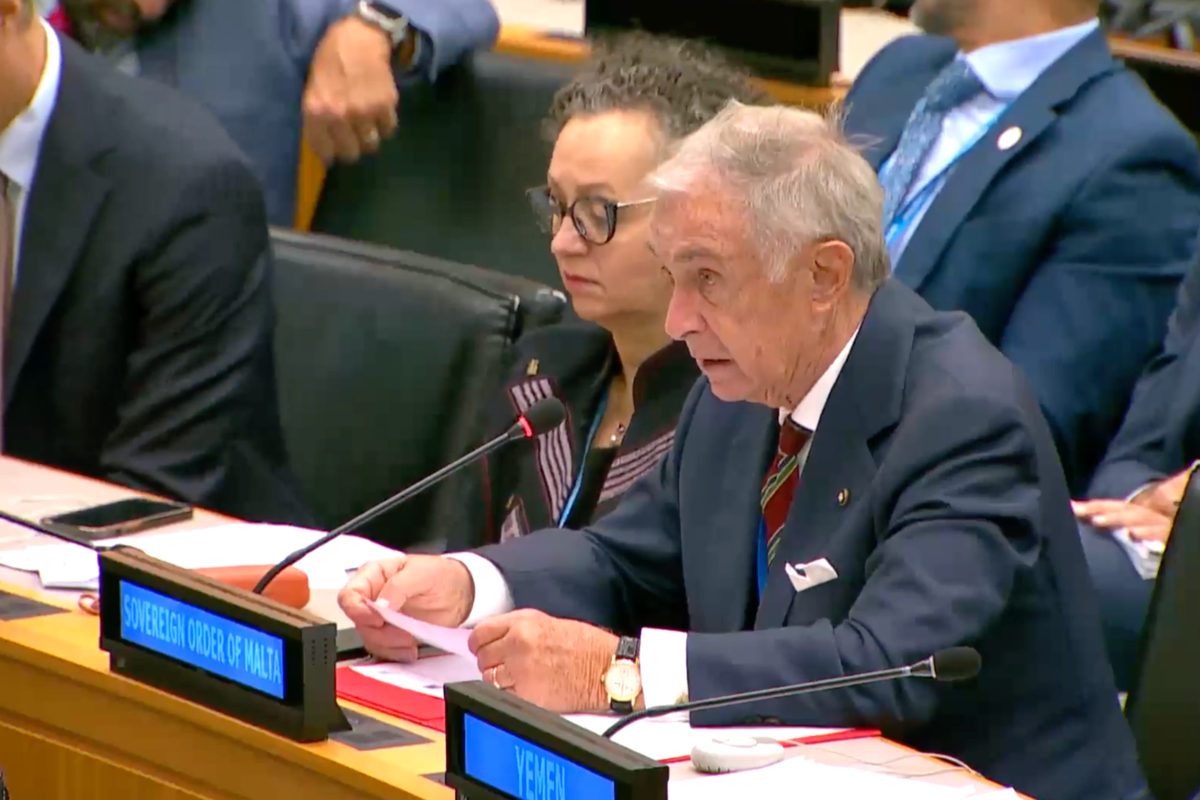
Deputy Permanent Observer Judge Brien Purcell Horan, speaking on behalf of the Sovereign Order of Malta, emphasized that leadership for peace must be grounded in humanitarian principles rather than political considerations, noting that every issue before the Council carries a profound humanitarian dimension. Judge Horan emphasized the Sovereign Order of Malta’s rare disposition, as one of the few voices at the United Nations mandated exclusively to speak for the sick, the poor, and the dispossessed, and underscored the indispensability of moral and principled leadership. He highlighted the severity of current global crises, including the unprecedented number of conflicts, the rise in displaced persons to 123 million, and record number of fatalities among humanitarian workers and journalists. He also highlighted how climate-related disasters and widespread violations of international humanitarian law, from Gaza to Ukraine to Sudan, further demonstrate the urgent need for principled global leadership.