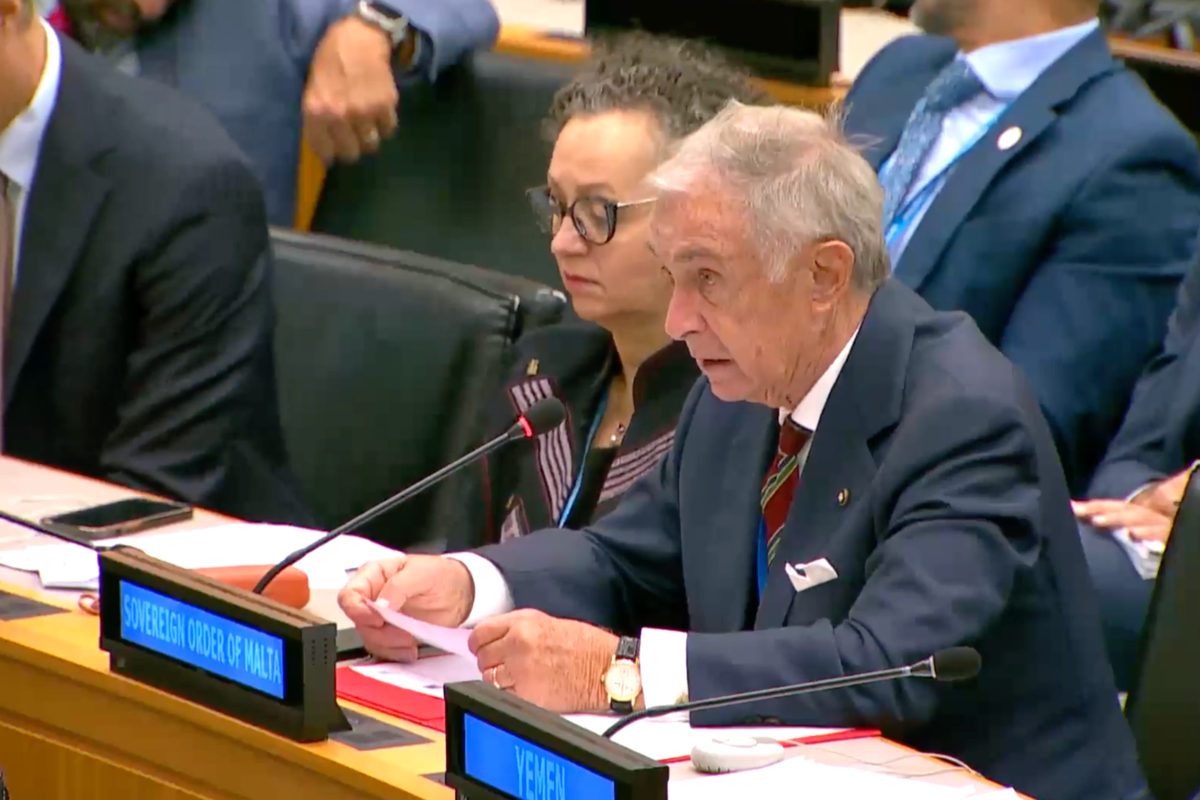
On 30 April 2026, the United Nations Security Council under the Presidency of the Kingdom of Bahrain convened to address the escalating crisis in the Middle East, including the Palestinian question. Ambassador Beresford-Hill, Permanent Observer of the Sovereign Order of Malta, gave an intervention which emphasized the Order’s role as a sovereign entity unencumbered by political agendas and solely dedicated to the service of the suffering, the sick, and the poor.
Ambassador Beresford-Hill expressed deep concern over the steady erosion of the religious status quo in the Holy Land. He noted that while the recent convergence of Easter, Ramadan, and Passover should have highlighted the region’s pluralism, restricted access to the Western Wall, the Church of the Holy Sepulchre, and the Al-Aqsa Mosque instead threatened the foundations of religious freedom. This climate of intolerance was further illustrated by the recent desecration of a statue in Lebanon, an act the Ambassador condemned as a severe violation of mutual respect. He also drew urgent attention to the alarming rise of antisemitism and religious hatred, which continue to fracture communities and undermine the dignity of faith.
The humanitarian situation in the region was described as a catastrophe, with the Ambassador highlighting the “arbitrary and capricious regulations” that prevent essential goods—including life-saving pharmaceuticals and incubators for newborns—from reaching those in need. He warned of the pervasive threat of water scarcity and the physical and fiscal paralysis in the West Bank, which has placed the healthcare system under immense strain. Invoking the words of Pope Leo XIV, who observed that “humanity cries out and pleads for peace,” the Ambassador reaffirmed that the protection of civilians, healthcare personnel, and humanitarian workers is a fundamental obligation that must never be subordinate to the conduct of hostilities.
Ambassador Beresford-Hill affirmed that every life lost is a tragedy and decried the cycle of self-perpetuating violence that seeks its excuse in history and its rationale in politics while destroying lives with impunity.
The intervention concluded with a call for the international community to safeguard the right to worship and ensure the unimpeded delivery of aid, anchored in the reminder: “Blessed are the peacemakers.”