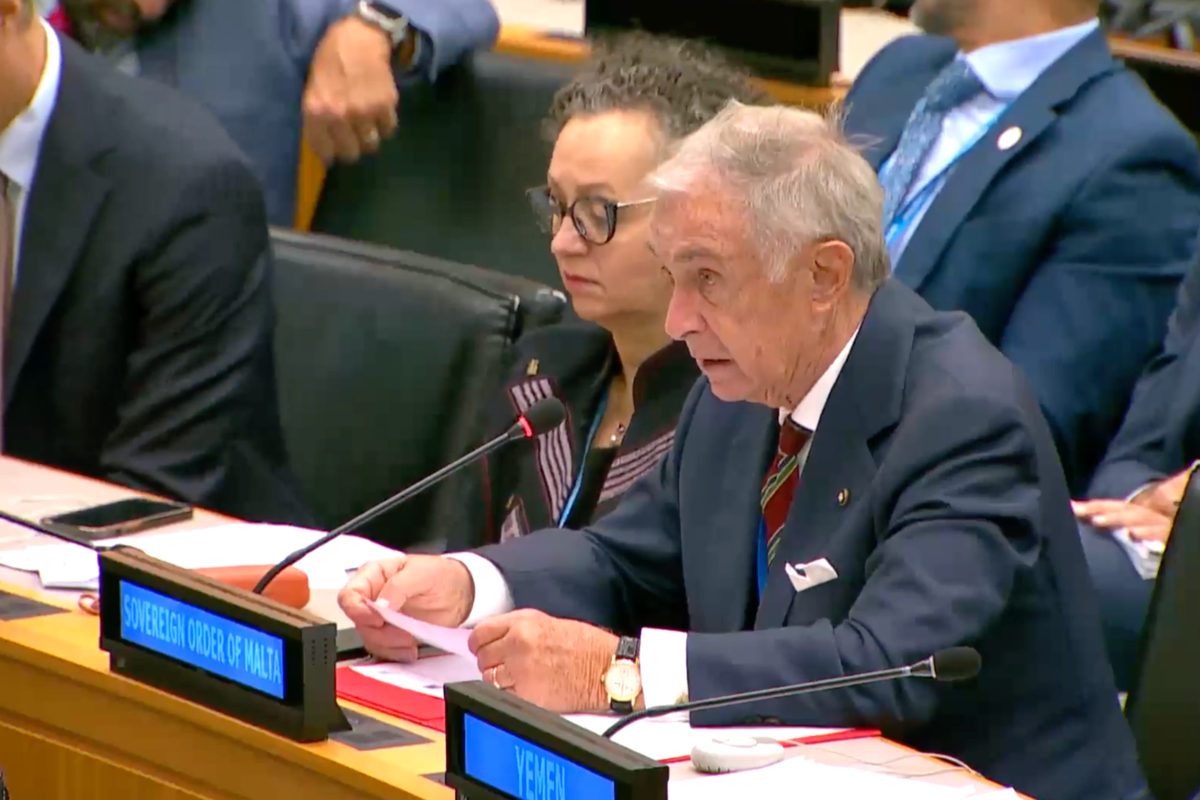
On 18 November 2025, the Security Council met under the Presidency of Sierra Leone to resume the open debate on conflict-related food insecurity. The briefing featured contributions from senior UN officials, the African Union, and the FAO, followed by an intervention delivered on behalf of the Sovereign Order of Malta by Ambassador Beresford-Hill.
Deputy Secretary-General H.E. Amina Mohammed warned that acute hunger has risen by fourteen million people in the past year, with Sudan now the world’s largest hunger emergency. She noted similarly grave situations in Gaza, Haiti, the Sahel, and the Democratic Republic of the Congo, stressing that conflict continues to devastate food systems, disrupt markets, and violate international humanitarian law. She called for assured humanitarian access, more sustainable and locally-driven food systems, and strengthened climate-adaptation efforts ahead of COP30.
Ms. Joyce Msuya, Assistant Secretary-General for Humanitarian Affairs, echoed the urgency of these trends. She highlighted the scale of needs in Yemen and Syria, where violence, explosive ordnance, and bureaucratic impediments continue to obstruct humanitarian operations. Recalling Security Council resolutions 2417 and 2573, she underscored that starvation as a method of warfare is unequivocally prohibited and urged stronger civilian-protection measures and accountability mechanisms.
FAO Chief Economist Máximo Torero noted that 636 million people “go to bed hungry,” emphasising that hunger and conflict reinforce one another. He outlined the critical role of the IPC system in identifying famine conditions, including recently in South Sudan and Gaza, and guiding timely, evidence-based response.
From a regional perspective, AU Special Envoy Dr. Ibrahim Assane Mayaki warned that by 2030 more than half of the world’s hungry will reside in Africa. He drew attention to the acute deterioration in Sudan, the DRC, and the Sahel, and called for the protection of food systems under international law, stronger early-warning tools, and financing aligned with African resilience and nutrition goals.
Member State interventions reflected broad consensus that conflict remains the primary driver of global hunger. Numerous delegations condemned the weaponisation of food, urged unimpeded humanitarian access, particularly in Gaza, Sudan, and South Sudan, and highlighted the need for early action on famine warnings. Climate vulnerability, structural inequalities in global food systems, and the importance of sustainable, long-term solutions were recurring themes.
Speaking for the Sovereign Order of Malta, Ambassador Beresford-Hill reaffirmed that the right to food is fundamental to human dignity and a prerequisite for peace. He condemned the deliberate obstruction of aid and the destruction of agricultural systems as clear violations of international humanitarian law. Stressing that hunger is a preventable injustice, he called for renewed international resolve to ensure that access to food never becomes a casualty of conflict. He recalled the words of Pope Leo XIV, who reminded the international community that “hunger is not humanity’s destiny, but its downfall.”
The discussion concluded with a shared recognition that addressing conflict-related hunger requires political will, accountability, and sustained investment in climate-resilient and locally grounded food systems, priorities that continue to guide the humanitarian mission of the Sovereign Order of Malta.